Making the Unequal Metropolis by Ansley T. Erickson
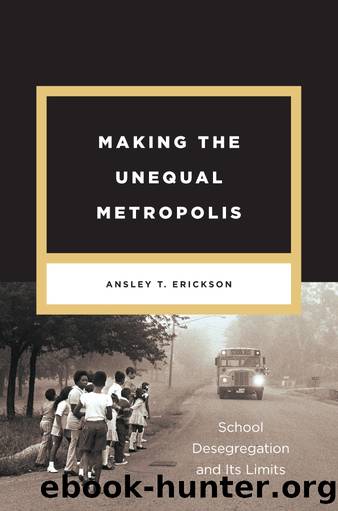
Author:Ansley T. Erickson [Erickson, Ansley T.]
Language: eng
Format: epub
ISBN: 9780226025391
Publisher: The University of Chicago Press
Published: 2016-03-17T00:00:00+00:00
Conclusion
Popular resistance to desegregation gave evidence of the depth of white commitment to defend the tight historic linkage between neighborhood, school, and segregation, a linkage challenged by busing. In Nashville, white resistance to busing became evident in a variety of formsâfrom aggressive picket lines at schools to begrudging and economically self-interested calls for compliance in elite circles. Even quieter processes of bureaucratic judgment and implementation, often working to shift the spatial and the curricular organization of schooling, remade inequality in busingâs first decade. These decisions often prioritized the felt needs of white and suburban families, particularly as compared to those of black families in the city core.
If considered a kind of public pedagogy, official choices about busing communicated to white families that they should appropriately expect their felt needs and desires to be prioritized above othersâ, to have their children deemed the chief focus of a school districtâs functioning. In this way, Nashville school officials were setting themselves up to compete for the affections of white familiesâto compete with surrounding and less demographically diverse exurban school systems, or local private schoolsâon terms on which the district could never win.
Vocational education, supported by a mixture of growth-minded and educational logics, made its mark on Nashville curriculum, but also transformed the spatial organization of high schooling in the city. Students who rode buses to high schools under court order for desegregation got off the bus at schools that grew larger and expanded their curricular offerings via state vocational funding. These schools sorted students between academic offerings and vocational programs. Inside schools, the state legislative encouragement to understand students as future workers set the context within which teachers made millions of decisions as they interacted with children.
The enlarged state role in worker preparation could seem to contradict the nearly simultaneous calls of anti-busing protestors for a less meddlesome state. Although anti-desegregation activism has rightly been portrayed as a seedbed of conservative politicsâand local activists surely protested busing as an invasion into treasured realms of family authority and home owner rightsâpressure for vocational education in Nashville highlights the nuances of that conservatism. It was not bluntly anti-state, but reflected a recalculation of the appropriate uses and targets of state power. The more targeted and explicitly redistributionist claims of busing for desegregation drew criticism as an inappropriate use of state power, although various manipulations in favor of segregation and white privilege appeared unremarkable. Meanwhile, expansive or even intrusive state efforts to link students to jobs could be supported in the name of economic growth amid claims of benefit to all. A new trickle-down logic was gaining hold, one that opposed direct assistance to historically underserved individuals or groups, but supported a more expansive use of state power in the name of growth with purportedly broadly distributed benefits.
Between Judge Mortonâs 1971 order for desegregation and the experiences of tens of thousands of Nashville students and families lay crucial decisionsâmade as frequently out of the glare of public attention as within itâthat shaped the basic structures and approaches of desegregation.
Download
This site does not store any files on its server. We only index and link to content provided by other sites. Please contact the content providers to delete copyright contents if any and email us, we'll remove relevant links or contents immediately.
| Anthropology | Archaeology |
| Philosophy | Politics & Government |
| Social Sciences | Sociology |
| Women's Studies |
Cecilia; Or, Memoirs of an Heiress — Volume 1 by Fanny Burney(32558)
The Great Music City by Andrea Baker(32019)
Cecilia; Or, Memoirs of an Heiress — Volume 2 by Fanny Burney(31956)
Cecilia; Or, Memoirs of an Heiress — Volume 3 by Fanny Burney(31942)
We're Going to Need More Wine by Gabrielle Union(19046)
All the Missing Girls by Megan Miranda(16028)
Pimp by Iceberg Slim(14508)
For the Love of Europe by Rick Steves(14121)
Bombshells: Glamour Girls of a Lifetime by Sullivan Steve(14075)
Talking to Strangers by Malcolm Gladwell(13370)
Norse Mythology by Gaiman Neil(13365)
Fifty Shades Freed by E L James(13241)
Mindhunter: Inside the FBI's Elite Serial Crime Unit by John E. Douglas & Mark Olshaker(9343)
Crazy Rich Asians by Kevin Kwan(9292)
The Lost Art of Listening by Michael P. Nichols(7506)
Enlightenment Now: The Case for Reason, Science, Humanism, and Progress by Steven Pinker(7313)
The Four Agreements by Don Miguel Ruiz(6765)
Bad Blood by John Carreyrou(6621)
Weapons of Math Destruction by Cathy O'Neil(6280)
